Monday, 11 September 2017

My visit to Dali University, Yunnan, China, as Visiting Professor... Part-5

Three major tourist attractions in Dali, Yunnan, China


Dali in Yunnan Province of China is well known for its varied tourist attractions and of which (i) ‘Erhai Lake’, (ii) ‘Dali ancient temple with 3 Pagodas’ and (iii) ‘Foreigner’s Street’ in the old City of Dali are said to be famous and one generally doesn’t miss to see. My host Prof Su ensured and squeezed these 3 items in our 2-week itinerary...

(i) Erhai Lake
In the shape of a human ear, Erhai Lake in Dali, situated at about 1900 m above sea level, is the second largest highland lake in China. The lake measures north-south 40 km and east-west about 7 km, covering an area of about 250 km2. The Dali city is located on the west bank of the lake.
The Erhai Lake is so spectacular....!  Accompanied by Ms Bao and Li, Mr Zonglong, drove us around the lake in the first week-end of our visit. Beautifully landscaped on either side, the motorway around the lake is a treat to drive. The lake receives water from rivers and streams of adjoining Cangshan Mountains and it has its inherent rich biodiversity in the form of endemic fishes, birds, butterflies, hydrophytes and of course freshwater fungi... Local people feel that the lake is their national treasure and they expend sincere efforts in maintaining the lake water always clean. The lake embodies a few small islands. Activities around the lake include controlled fishing, farming, parks, temples and varied eateries. The whole place is absolutely clean.  There are clean toilets at intervals along the motorway and none uses the lake-shores to ease out. Being Sunday, we saw many small crowds thronged to lake-sides for family/marriage photo-shootings.  Water from the lake eventually flows down into the mighty Lancang or Mekong River.....

 On the way to Erhai Lake from Old City of Dali 

 Panoramic view of Erhai Lake


 I and my wife...!

 With Mr Zonglong

 I and my wife with Bao and Li 


 Panoramic view of Dali University as seen from other side of Erkai Lake


 Beautifully landscaped motorways...


(ii) Ancient Chongsheng Temple and 3 Pagodas
Dali is singularly famous for its ancient Buddhist architecture Chongsheng temple and three Pagodas, dating Nanzhao and Ming Dynasty of 8th and 9th centuries. Seen from far off, with a backdrop of majestic Cangshan Mountains, the temple and pagodas are just 2 km away from Dali University. We visited this serene scenic spot in the second week-end. Prof Su’s research students, Ms Na and Li, not only accompanied us but also explained my queries with minutest details.
The three independent, cream-coloured, majestic pagodas are located equidistant in a symmetric triangle. The main and centrally located pagoda is about 70 m high whereas the adjoining 2 are smaller and about 42 m high.  They are interiorly hollow but occupied by Buddha statues.
With Ms Na, I made a brisk walk of about 2 km from the fist entrance to the final sanctum sanctorum of Chongsheng temple where stunning but tranquil statue of Buddha stood tall with a blessing palm or dhyan-mudra. Na showed me the procedure of paying religious obeisance at the temple. Temple serenity spread over the whole place...

 Three Pagodas in the ancient city of Dali
 My wife with Na and Li in front of amazing 3 Pagodas

 Main, centrally located Pagoda

 One of smaller two Pagodas

 Chongsheng Temple

 Bhagwaan Buddha...


 Magnificent statue of Buddha
 Magnificent statue of Buddha


 On the way back from Temple....


The Chongsheng Temple


 The Chongsheng temple and three Pagodas are truly amazing....


(iii)  Foreigner’s Street in old city of Dali:
Week-end evening walking streets are special attractions in most Asian countries and China is no exception. I have seen these in Thailand and Foreigners Street in the old city of Dali is very famous for its display of Chinese goods of tourist interest. My wife showed  interest to walk along the street. Accompanied by Bao, Na and Li, we went around the street and my wife picked up a few small bits and pieces of interest as souvenir to bring back home. I particularly sawthat the whole place is absolutely clean, descent and attractive with display of Chinese style decoratives, ethnic clothes, handicrafts, silverwares, eateries, music and charm. We enjoyed the evening....

 Signboard of Foreigner's Street


 It's all colourful everywhere....


 Walking street in the evening at Old City of Dali is simply beautiful...


D. Jayarama Bhat
(To Continue...)  


Sunday, 10 September 2017

My visit to Dali University, Yunnan, China, as Visiting Professor... Part-4

We tasted ‘Szechwan pepper’....

During our stay in Dali, Yunnan, China, I and my wife tasted a variety of Chinese cuisines, but in vegetarian form. Our son, a foodie, through WhatsApp queried if we have tasted dishes incorporated with ‘Szechwan pepper’. We knew black and white pepper varieties, but couldn’t quickly pick up this new Chinese pepper....!
Szechwan’ or Sichuan pepper or Chinese pepper is an interesting spice, used in several Chinese non-vegetarian cuisines in Dali, Yunnan, China. Though it is not uncommon in southern India and even Nepal and Thailand, surprisingly we had not tasted this earlier, apparently because of our vegetarianism....
In Konkani and Marathi, Szechwan pepper is called ‘tephal’ or ‘triphal’. In view of its pungent, biting taste and deep, penetrating fragrance, it is also called as ‘mistress of spices’. Though grown in several parts of Konkan and coastal Karnataka, shame it is, we had not seen this plant so far. Sichuan pepper is used I believe mostly in fish-curries in Maharastra and part of Karnataka in southern India.  A species of Zanthoxyllum and member of citrus family Rutaceae, Szechwan is very pungent and hot, hot.... I tried both fresh and dry pepper, in Dali. Eaten raw, it numbs your lips....; and it has an interesting, slowly penetrating aroma...! The dried husk around the black, shining seeds is the ingredient used in curries.
In most Chinese Szechwan cooking, they use this pepper. Hot dishes roll out the pepper fragrance all around the dining hall, within minutes. Prof. Su ensured that a vegetarian alternative was prepared and served to us in Dali. What an amazing taste it was..!. The tingling and numbing taste lasted a couple of hours in my mouth...!  Prof. Su took me to Dali University campus and showed a small tree in the backyard of a staff quarters. I was told that the species we saw is Zanthoxyllum schiniffolium. I am told that Chinese also use this pepper as an ingredient in certain herbal medicines.
Said to be the culinary cousin to black or white pepper, Szechwan is used in some of south Indian fish-based non-vegetarian dishes for which unfortunately I have no taste buds. The plant grows like a shrub or a small evergreen tree and produces red, warty fruits. Raw fruits are very pungent. Dried fruit husks hold the fragrance for a year, if stored in air-tight containers.
Szechwan pepper is a new entrant in our kitchen shelf......!

 Szechwan pepper tree in Dali with red fruits

 It's a small, evergreen tree

 Freshly harvested fruits

 Dried fruit-husk, as spice...

Vegetarian dish embedded with Szechwan pepper, in Dali


D. Jayarama Bhat

(To continue...)


Thursday, 7 September 2017

My visit to Dali University, Yunnan, China, as Visiting Professor... Part-3

We enjoyed ‘Song-rong’ (Tricholoma matsutake Ito & Tmai) Singer, a high-value mushroom delicacy in China...


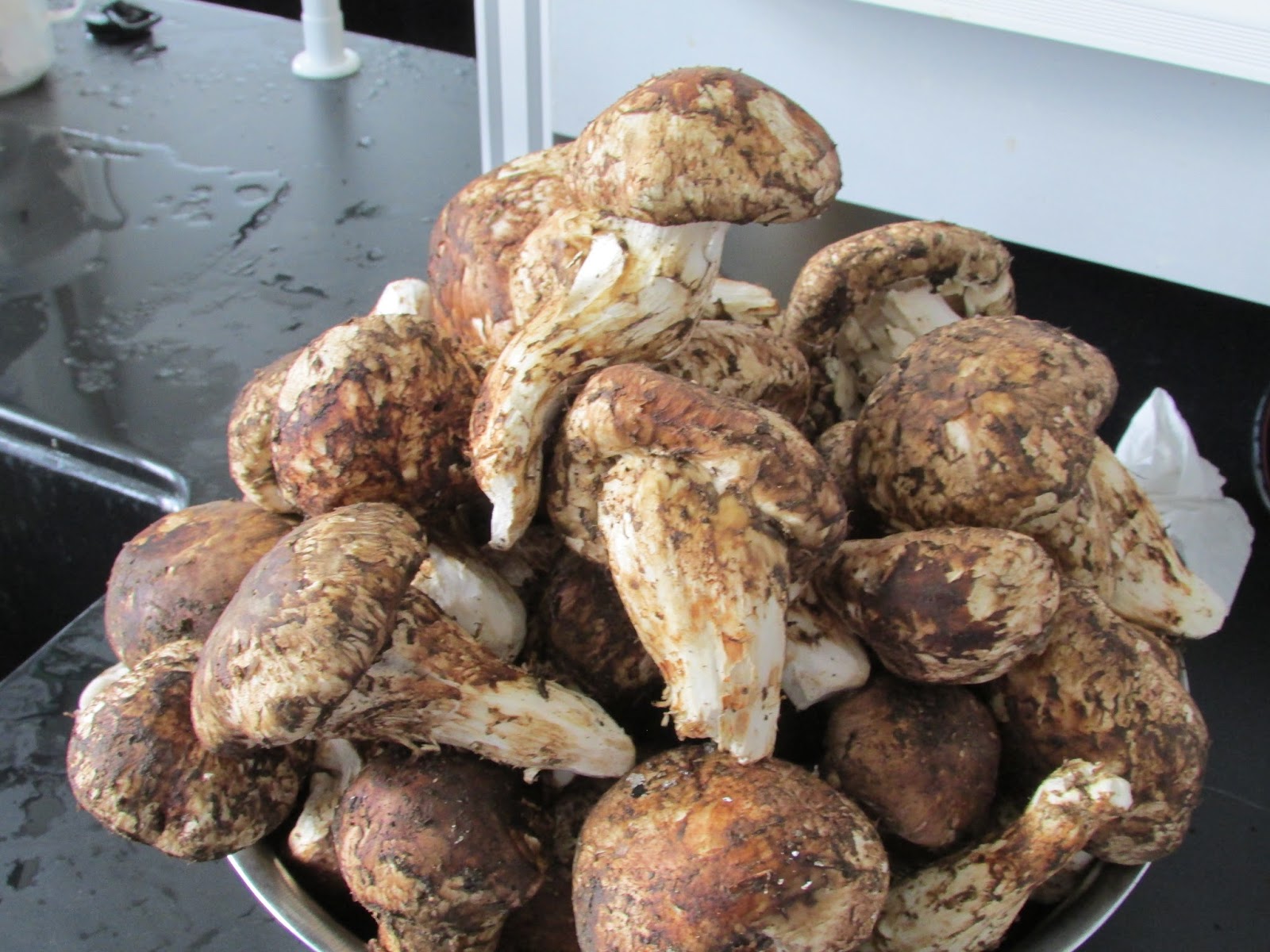
On the 4th day of our visit in Dali University, Yunnan, China, I found Prof. Su in the Department quite excited, in the morning. I asked the reason for her exhilaration. She showed a bag-full of big-sized, white to brown-coloured robust mushrooms called ‘Song-rong’, botanically known as Tricholoma matsutake (Ito & Tmai) Singer, which she bought in the open market in old city of Dali, Yunnan, China.

These robust, brown-coloured mushrooms had 5-15 cm wide cap and 5-12 cm long stalk or stipe. The stipe was quite filled and sturdy. I was curious to know more about the fungus. Tricholoma matsutake, locally called ‘Song-rong’ or ‘Matsutake’ meaning ‘pine mushroom’ in Chinese (matsu = pine; take = mushroom), has a distinct aromatic odour (like chilled cinnamon?) and is a highly sought after mushroom in China. The fungus grows in mycorrhizal symbiotic association with tree-roots and the fungus is common in high altitude mountains of Yunnan province (1800-2200 m) where pine plantations (Pinus yunnensis) are predominant. In autumn (July to October), the mushrooms appear in plenty in pine tree-bases and local villagers harvest Song rong and sell in open market across Yunnan. Song rong or Matsutake is said to be the costliest among the wild edible mushrooms of China.... 

Known as a culinary delicacy from the time of Song dynasty in 1050 AD, Song-rong or Matsutake is said to bring good fortune and fertility in the society in China. The villagers harvest the mushrooms, sort out and grade them (based on size and closeness of cap) before bringing to the market. Freshly harvested mushrooms are in very high demand. Soon after purchase, the mushrooms are cleaned, sliced and eaten either raw or par-boiled. The sliced mushrooms are also sun-dried, canned and stored for consumption in off season. 

Interestingly, song-rong is also eaten raw. Prof. Su desired and further ensured that I eat enough Matsutake mushroom, in view of its rarity and delicacy, during lunch that day. Accordingly, the whole aquatic fungi group got readied, carefully scraped the surface mud using scalpel and thoroughly washed the mushrooms in running tap water. The king of mushrooms was ready for consumption. Mr Zonglong had brought ‘wasabi’ (pungent chilli paste) from market, mixed it with soya sauce. The fresh, clean mushroom was thinly sliced, dipped in wasabi-soya sauce solution and eaten raw. I ate plenty. The intense odour of mushroom was like ‘chilled cinnamon’. I didn’t know till then that mushrooms also are eaten raw. It was a whole new experience....

Prof. Su and the group sliced the whole lot of Song-rong mushrooms, sun-dried and canned in air-tight plastic containers. I understand that they would rehydrate the sliced mushrooms and prepare mushroom soup in off-seasons. 

I am truly fortunate to have eaten this great, king of mushrooms in this trip to China.....! 


 Freshly harvested Song rong mushrooms 


 King of mushrooms

 Cleaning the mushrooms

 Thinly slicing the mushrooms

 Sliced mushrooms

 Sun-drying the sliced mushrooms

 Fresh, sliced mushroom eaten raw...!

  Wasabi and soya sauce


D. Jayarama Bhat, M.Sc., Ph.D., D.Sc.


(To continue....)     


Tuesday, 5 September 2017

My visit to Dali University, Yunnan, China, as Visiting Professor... Part-2: Looking at microfungi .......

Microfungi
Fungi grow in diverse habitats and substrates. With a variety of digestive enzymes, fungi decompose dead organic matter of plant or animal origin and thereby aid in recycling the huge amount of waste that gets accumulated on the face of this earth. Fungi are considered as world’s best biodegraders...
As part of global/national biodiversity documentation programme, fungi are collected from different habitats, taxonomically identified and preserved in live or dead form in repositories and harbaria. Countries around the world including India have taken initiatives in this direction. While in service, along with my students I have done this exercise extensively with great interest and documented the micro-fungi of forests and freshwater streams of Western Ghats in southern India in  a big way.  Post-retirement, I offer free assistance in fungal identifications to needy institutions and scholars.... 
Aware of my expertise on fungal taxonomy, especially asexual-morph fungi, a couple of institutions invited me for short duration, seeking help. What is more exciting for me than seeing fungi...! It’s sheer joy that I derive from this exercise....  

Aquatic Fungi in Dali University 
Yunnan in south-west of China is a mountainous area. While travelling along the Kunming-Dali highway, we had glimpses of some of these mighty mountain peaks. There are several rivers and one of the major watercourses in the province being Mekong river which further flows down as boundaries between Laos and Myanmar and then between Laos and Thailand. Yunnan province is also known to have largest diversity of plant and animal life in China.
Prof. Hongyan Su, my host in Dali University, is handling a major research project aimed at exploring aquatic fungi of Yunnan province including the Mekong river upper catchment area. Along with students, she carried out numerous field trips to different rivers and sourced sizable quantity of fungal specimens which they processed further. They prepared neat slides of the fungi, examined them under microscope, took photo-micrographic pictures, wrote descriptions and cultured in agar media and further sequenced the fungal genomes.  
On reaching Dali, from the very next day, I sat with them and looked at these fungi. I helped them to taxonomically identify and document the fungi. The aquatic fungi of Yunnan are undoubtedly very huge in their diversity. Besides, I gave a couple of class-room presentations and explained how to work and identify the fungi. No doubt, we encountered several novelties and to my great surprise I saw many of the fungi for the first time in my mycological journey. I knew many of those only in literature. Such an amazing fungal diversity we saw.  Students of Prof Su are hard working, studious and methodical and more than that they are very eager to learn.  Excellent pictures they took. Time ran speedily and meantime we saw numerous fungi....

Prof. Su's Lab

 We looked at numerous fungi 


 I gave a lecture on how to work with Microfungi

 With Mr Zonglong who coordinated my visit to Dali University

 With my host, Prof. Hogyan Su, Dean College of 
Agriculture & Biotechnology, Dali University

 When I lectured on fungi


D. Jayarama Bhat

(To continue...)       


Monday, 4 September 2017

My visit to Dali University, Yunnan, China, as Visiting Professor... 
Part-1

Origin of this trip:
Mr. Lu Zonglong, one of the research scholars at Mae Fah Luang University, Chiang Rai, Thailand, asked me last year while I was there as a Visiting Professor, whether I would consider a visit to his University for a short duration.... On query, he replied that he comes from Dali University, Yunnan Province, China and his supervisor Prof Hongyan Su, Dean, College of Agriculture & Biotechnology, Dali University, handles a major research project on aquatic fungi of mountain streams of Yunnan Province in south-western China, including the upper Mekong river catchment area. My curiosity naturally rose when he said it is regarding looking at aquatic micro-fungi which is very dear to me...

Preparations:
Mr Zonglong and his mentor at Dali University Prof Su worked out a brief programme and invited me as Visiting Professor to Dali University for a short duration of my choice time. We agreed upon that convenient time would be later half of August 2017. Along with an invitation letter, they sent return travel tickets to me and my wife, the route being Goa-Delhi-Kunming by fight and Kunming-Dali by road. I obtained our travel Visa from Chinese Consulate in New Delhi. 

Our trip to Dali via Kunming:
We set out to Dali, Yunnan, China, on 14th August 2017. We left Goa at 8:30 am, our flights were on time and we reached Kunming airport at 10:30 pm local time. Authorities at both Delhi and Kunming airports were very courteous and helpful. As we came out of the airport in Kunming, Mr. Zonglong received us with an affectionate smile and hug. He accommodated us in a nice place ‘Nissi Holiday Hotel’ in Kunming that night.
At departure lounge, Delhi Indira Gandhi International Airport

Overnight stay in Kunming

Located about 1900 m above sea level, Kunming, the capital of Yunnan Province in south-west of China, is known as the ‘city of eternal cool’ for its pleasant climate and greenery round the year. It was said to be the gateway to ‘silk road’ in early times that facilitated trade with India, Myanmar and beyond. Today it is the provincial modern capital of Yunnan and most popular tourist destination in southwest China.

Road travel from Kunming to Dali:
We got ready early next day. Taking bread-butter, baked beans, fruits and coffee as breakfast in the hotel, along with Mr Zonglong we set out to Dali in a hired car at 9:00 am. Kunming to Dali, 330 km 6-lane highway, was a pleasant drive. Though we had intermittent rain on the way, the car took us to our destination in 4 hours. For my queries, our friend Zonglong gave detailed explanations on places, people and culture of the region. Beautifully landscaped motorway from Kunming to Dali with several well-lit tunnels, it’s picturesque all along! High mountains, valleys and cultivated fields, it is green everywhere. People of north-west of China cultivate predominantly maize along the slopes this time of the year and besides we saw stretches of fruit orchards and pine forests. At intervals along the road, there are gas stations coupled with restaurants and washrooms.
I particularly noticed that the cities of Kunming, Dali and entire stretch of Kunming-Dali highway are absolutely clean. We didn’t see even a piece of paper or plastic littered anywhere on the roadsides, public places and parks. Those washrooms along the motorway were absolutely clean and sparkling...! Such clean places are prerequisites for a good living....
6-lane highway from Kunming to Dali is a high-speed motorway...

 Maize cultivation along the slopes in Yunnan province

Amazing road network in China
  
Roads, crisscrossed by road and rail-flyovers.....
On reaching Dali:
We reached Dali at 1:30 pm local time. Prof. Hongyan Su fondly received us at the entrance of City of Dali and took us straight to a restaurant named ‘84000WAYS’ for lunch. Her research students also joined for lunch. It was a sumptuous vegetarian meal with rice, noodles, curry, mushroom pizza, baked vegetables and an aromatic spicy pumpkin soup. I queried with chief chef on the name of the hotel; she replied that it meant Lord Buddha preaching 84000 ways of attaining peace and enlightenment..... Noble thought indeed! 

With Prof Su (in black) and her research students 

After lunch, we were taken to the place of our stay, a nice accommodation in the proximity of Dali University, where we resided next two weeks... 

D. Jayarama Bhat

(To continue....)