Tuesday, 21 November 2017


Plastics and Swatch Bharat

Plastic and plastic products have become part of our daily life. The plastic products, everything that we use today, from ordinary carry-bags to eating plates, injection syringes to surgical tools, chairs, tables, and numerous other electronic appliances, are used and disposed off so casually almost everywhere... Heaps of plastic are seen accumulated on roadsides, drainage, fields, forests, rivers, sea-shores, beaches and everywhere. It’s truly horrifying..!  

If we want to achieve cleanliness of our surroundings and eventually Swatch Bharat, first we must reduce or avoid indiscriminate use of plastic and plastic products. This move demands search for or development of a suitable degradable substitute for plastic. There are a few biodegradable products in use, in every area of our living, from catering to medical, but none of them has made a big headway as a total substitute to plastic. 


Search for a sustainable alternative to plastic should therefore be a priority area of interest....

D. Jayarama Bhat

Sunday, 5 November 2017

Birthday and fungi.......

Birthdays are just annual memos of adding a number to ones age; it’s a time-bound message or reminder of the process of growth. It is realised that as one gets aged, the ability to respond or react is subdued, both physically and mentally. Yet, thanks to advancement in science and greater awareness of hygiene in living conditions; most perform well sufficiently long period of time, these days......

Stepping into 69, I fondly greet my dear and near ones, friends and all well-wishers for making our life meaningful..........

 (In front of Murudeshwar temple)

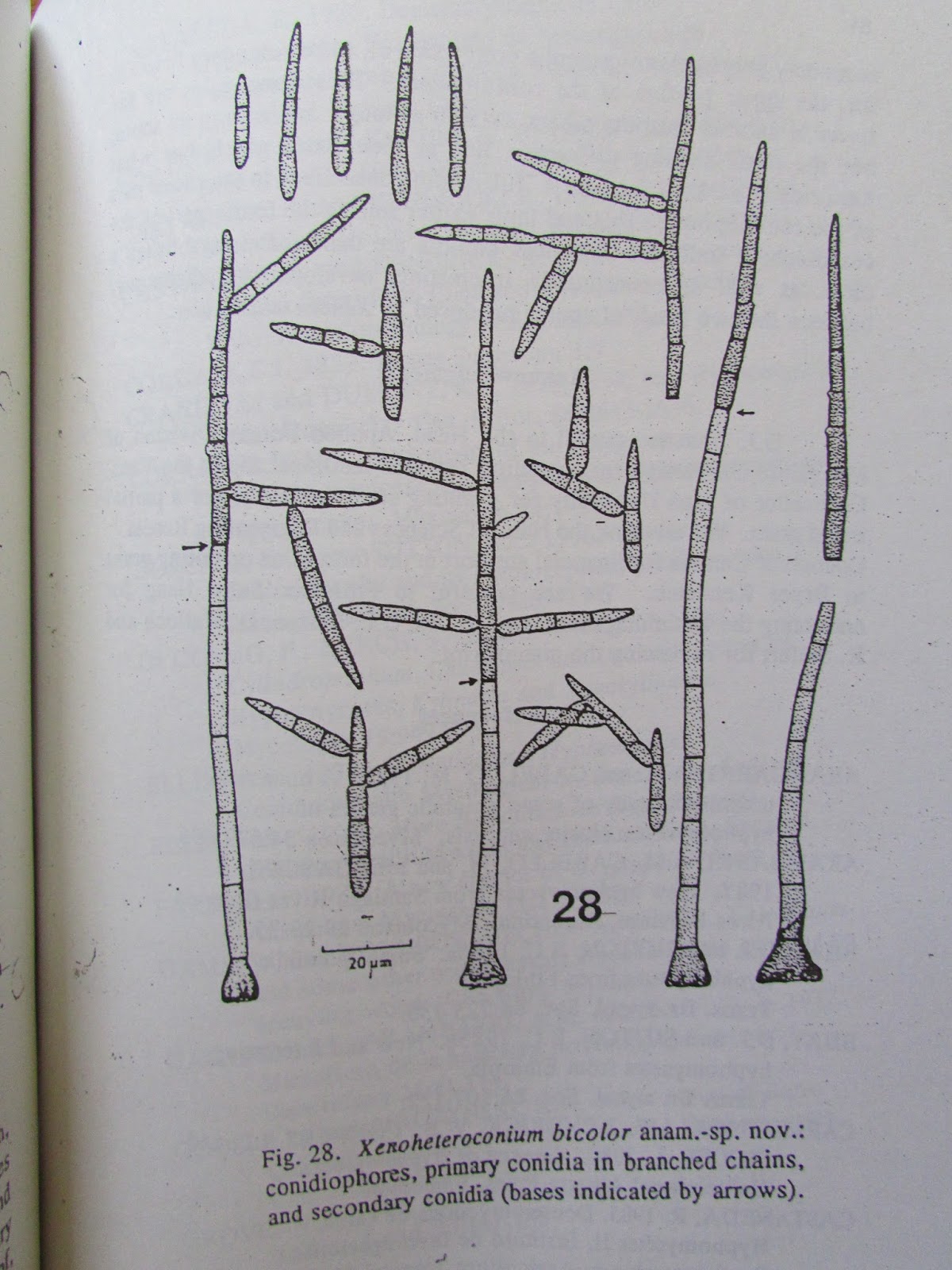
In 1993, I described, illustrated and named an interesting and novel asexual-morph fungus as Xenoheteroconium bicolor Bhat W.B. Kendrick & Nag Raj, (Bhat et al. 1993, in Mycotaxon) isolated from decaying leaf litter, collected from Agumbe, a small village in malnad region of Karnataka. This region, earlier called the Cherrapunji of southern India because of very high yearly rainfall, had thick, moist-deciduous forests those days....... 
This microscopic, saprophytic, hyphomycetous fungus, Xenoheteroconium bicolour, was interesting in that it produced two types of septate conidia: first, long primary conidia developed holoblastically, in small acropetal chains, on mononemtous conidiophores; second, short secondary conidia developed as lateral branches, on primary conidia.
  

 (Xenoheteroconium bicolour from India)

I had been to Agumbe a few times subsequently, accompanying students on field expeditions. I always had a feeling in my mind that I will see Xenoheteroconium again, because it has been my thinking that fungi are always there in nature.  Unfortunately, I didn’t get to see the fungus again.... Such issues when get recapitulated in our minds, thoughts often come; where are these fungi......?

During my recent visit to Dali University in China, I saw a M.Sc. dissertation in the Department of Agriculture and Biotechnology, with description and illustration of Xenoheteroconium bicolor that they sourced from leaf litter collected from the forests of Yunnan Province, China, in 2010.  I saw hardly any difference; morphologically, it was the same fungus as ours....!  
   

(Xenoheteroconium bicolour from China)

Perusal of literature indicates that some of the fungi described from the forests of India are rediscovered/redescribed from the jungles of other Asian and Latin American countries. From look, they all seem similar! I call this a sort of 'discontinuous distribution' of fungi across the globe.......... 

This of course tells that fungi are everywhere...!

D. Jayarama Bhat


Monday, 2 October 2017

Vidyadashami and Swatch Bharath....

‘Vidyadashami’ is an event of worshiping of deity Saraswati or Sharada, the goddess of education. As per Hindu calendar, this year it was performed on Friday and/or Saturday, 29/30 Sept 2017, at the end of Navrathri or Dussehra celebrations. Deity Saraswati, believed to be imparting literacy and education in humankind, is also said to be one of the noble incarnations of Goddess Durga. Books and educational tools are worshiped on this day.  We placed books in front of our family deity and worshiped Goddess Saraswati, last Saturday.....


Literacy and education, though interconnected, are pragmatically two different issues. If we can write, read or sign, for many, it means we are literate. Education is beyond this and means understanding a subject or an issue. Literacy generally leads to education...

I am writing below one of glaring examples of hitherto failure in getting educated in day-to-day living style, though large part of our country today boasts as literate. Our honourable Prime Minister, Shri Narandrabhai  Modiji, couple of years ago appealed all citizens that our premises and surroundings - be it schools, offices, government buildings, roads, public places, parks, beaches, rivers, lakes and everywhere, should be clean from all kinds of litter and refuses. He made this appeal primarily because most part of our country so far remained untidy and dirty. Heaps of garbage and refuses are seen thrown around on roadsides, public places and everywhere. This is partly because of the absence of proper garbage collection and disposal machinery and partly due to our indifferent attitude towards cleanliness in public places. We throw our refuses anywhere and everywhere, be in villages or those dwelling in urban areas. In spite of our PM’s appeal, little has changed on ground in the last two years. Why....? Are we not educated enough to understand his appeal....?

Maintenance of clean surroundings is not rocket science. Everyone knows this and it should be our way of life. Sad it is; we don’t practice cleanliness in all places...  Swatch is possible only if we are conscious and practice cleanliness and hygiene in our daily life. Let us not throw anything and everything around.  Let us put our refuses in garbage collection bins. Let us segregate biodegradable and non-degradable waste before disposal... Let us discontinue use plastics, as far as possible. If each one of us practices this not only in our houses but also public places we will have ‘Swatch Bharath’ or ‘Clean India’, very soon.  Otherwise, we will continue to live in dirt and remain uneducated..........

Today, 02 October 2017, is ‘Gandhi Jayanthi’. Let all of us take a pledge to maintain and practice clean surroundings everywhere, our premises and public places. Then only the dream of ‘Swatch Bharath’ can be realised.......

 Jai Hind!  
D. Jayarama Bhat


Wednesday, 27 September 2017

Butterflies............

Since middle of last week,  ‘Navratri’ (Sept 21-30) is celebrated with piousness and pomp across the country... Goddess Durga is worshiped for nine days and the festivity will culminate this weekend with Vijay-dashami Puja. Same time, upper-cyclonic air-depressions in the Arabian Sea and Bay of Bengal, with retreating monsoon, have impacted with sporadic rains all along the west-cost of India....

I and my wife went to our native place located in a village in the foothills of Western Ghats, to participate in a family function. People in this part of Karnataka are dedicated, progressive agriculturists. They grow paddy, areca, black pepper, cashew, coconut, banana, cacao and seasonal vegetables, besides dairy farming. It’s all hard labour...; I admire their dedicated efforts in and reaping the benefits of farming...

Remote village, I sat in the porch of our ancestral house and watched the occasional rains accompanied by lightning and thunder. Enchanting weather; it was green, green everywhere.....! I saw lots and varieties of butterflies, fluttering their wings, continuously hovering on wild and cultivated flowers in our courtyard. It was an amazing sight..!  I watched for a while and eventually caught them in my small camera......

Beauty has many facets....  


D. Jayarama Bhat  


Tuesday, 12 September 2017

My visit to Dali University, Yunnan, China, as Visiting Professor….. Part-6

We visited Yunnan Mushroom World Biotechnology Co Ltd. in Kunming, China


On completion of my 2-week brief assignment of Visiting Professorship at the Institute of Eastern Himalaya Biodiversity, College of Agriculture & Biotechnology, Dali University, Yunnan, China, I and my wife got readied to return to India, end of August 2017. Besides our routine luggage, our bags were filled with packets of green tea of varied taste. I was singularly fascinated sipping multitude varieties of green tea in China. Prof Su patiently explained the subtle differences of these exotic varieties of teas, in colour, taste and aroma, the prime of these being the ‘Puerh Tea’. I believe Puerh tea, fermented by a native strain of Aspergillus acidus, is produced only in Yunnan Province, China…

A couple of days before, our friend Mr Zonglong informed that Dr. Qi Zhao (nicknamed Papaya) who was earlier a research student at Mae Fah Luang University, Chiang Rai, Thailand and presently a successful mushroom entrepreneur in Kunming desired that we visit his mushroom farm on our way back home. I tried to figure out the face of this person from my memory box and realised the brief interactions that I had with Papaya in Chiang Rai.  Invitation to visit to a mushroom cultivation centre, my excitement automatically rose beyond boundaries…… 

Thanking Prof Su and her students, we left Dali by car at 9:00 am. Pleasant weather and the same Dali-Kunming 6-lane motorway; we reached Kunming at 1:30 pm. Nearing the city, the cab drove us straight to ‘Yunnan Mushroom World Biotechnology Co. Ltd.’, located in the outskirts of city of Kunming, on the bank of Dianchi Lake, another large highland lake in Yunnan Province. As we entered the Mushroom Farm, Papaya received us with a broad smile and warm handshake. He profusely thanked me and my wife for accepting his invitation and took us straight to the dining hall where his wife had arranged an elaborate lunch, main items being varied types of mushrooms freshly harvested from his farm.
      
It was a hot-pot lunch on a revolving dining table fitted with many induction plates. The hot-pot in front of us had noodles in boiling water to which curry-ingredients were added. Dr Jack, another old student of MFU and friend, joined us for lunch. Papaya assisted us to put sliced vegetables and different types of mushrooms which included Auricularia fuscosuccinea, Morchella sextelata, Phallus indisiatus, Pleurotus eryngii, Tremella aurentialba and tofu into the hot-pot. We ate plenty of mushrooms and tofu and it was indeed a memorable lunch. My experience eating mushrooms has so far been limited only to or button mushroom (Agaricus bisporus) which is very common in India.

After this luxurious mushroom meal and lots of green tea, we set out to Papaya’s mushroom farm. It is a newly set-up, one-year old, high-tech, temperature-humidity-controlled mushroom cultivation centre, spread over a few acres area. I was fascinated seeing his diligence, ingenuity and organisational skills in running the system. Everything operated like a clock in his farm, for time and speed. Mushroom cultivation is not an easy task; it’s a very sensitive crop. The mushroom strains used for large-scale cultivation by Papaya are his own collections from the wild and subsequently domesticated and improved by him. Mostly subtropical species, he harvests a sizable crop which amounts to a few tons per week and is sold either fresh or processed. I was spell bound watching the large-scale cultivation of ear mushroom (Auricularia), oyster mushroom (Pleurotus), cauliflower mushroom (Tremella) and bracket mushroom (Ganoderma) in his farm. Seeing Papaya’s firm is a great learning. Driving to the city of Kunming in the evening, he hosted us a dinner, before parting.  I and my wife thanked him for his hospitality and wished best of luck in his future adventures. 

We spent some time with our good friend Dr Sam, a specialist in macrofungi working in Kunming Institute of Technology, who came specially to see us...! End of the day, I felt deeply happy and blissfully contented seeing these many young, highly talented, dynamic, mycologists from different Asian countries with whom friendship blossomed following my academic visits to Mae Fah Luang University, Thailand, and College of Agriculture & Biotechnology, Dali University, China.

Next day, Mr Zonglong, who saw that we were taken care of so well all through, escorted us to Kunming International airport from where we flew back to Delhi and Goa.... The excitement and joy derived of academic interactions with students of mycology whom I met, places seen, foods tasted, knowledge gained and above all human values earned during this brief trip to Dali University are truly remarkable and profoundly huge...... 


 Yunnan Mushroom World Biotechnology Co Ltd. in Kunming, China


 Mushroom-based lunch at Mushroom World...

 Mushroom menu


 Taking lunch with Dr. Qi Zhao (Papaya), Mr Zonglong and Dr Jack 


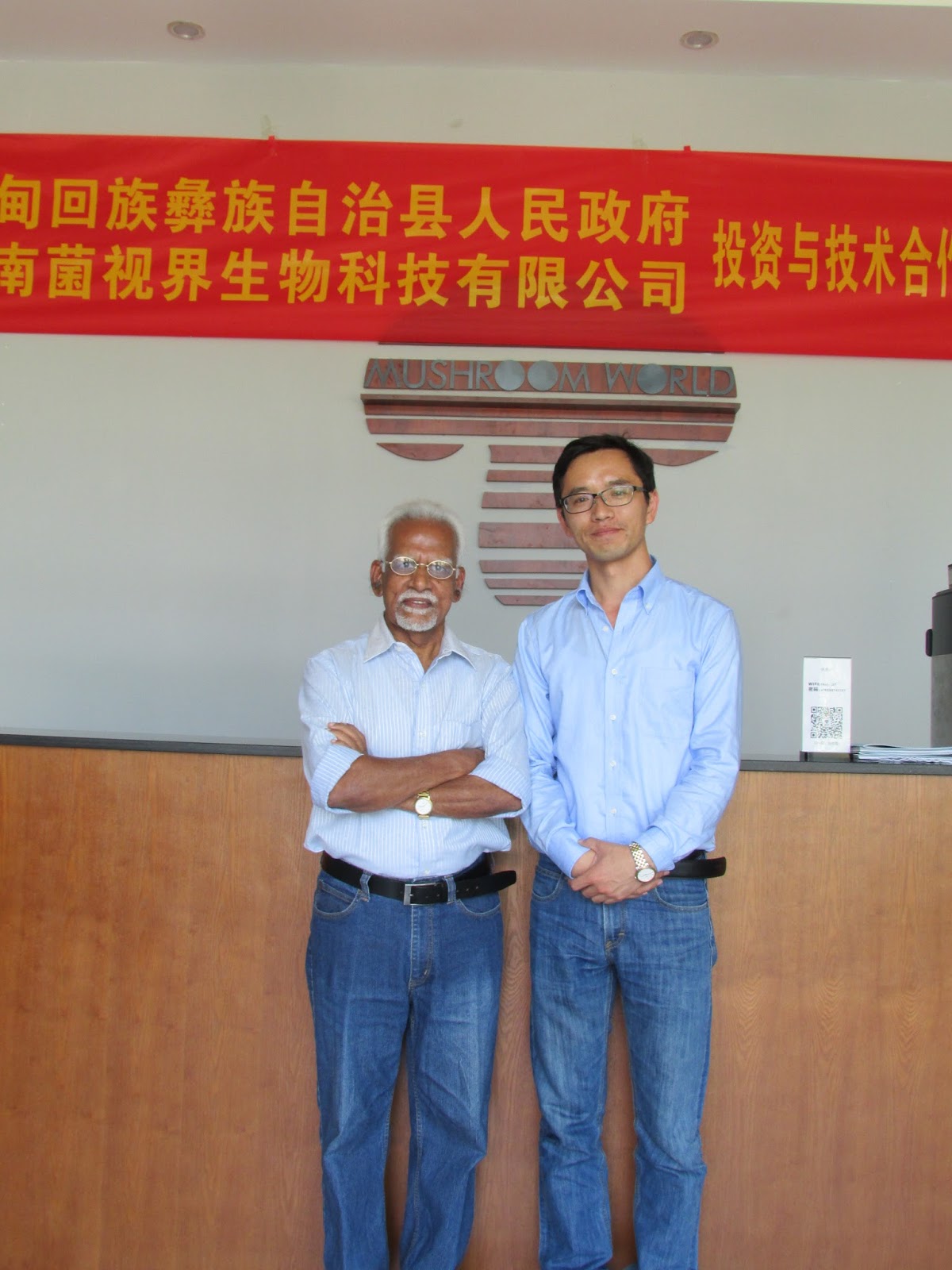
 With my friend, Dr. Qi Zhao (Papaya) at Mushroom World
 

 Cultivation of bracket fungus (Ganoderma)

 Cultivation of cauliflower mushroom (Tremella aurentialba)


 Cultivation of oyster mushroom (Pleurotus eryngii)


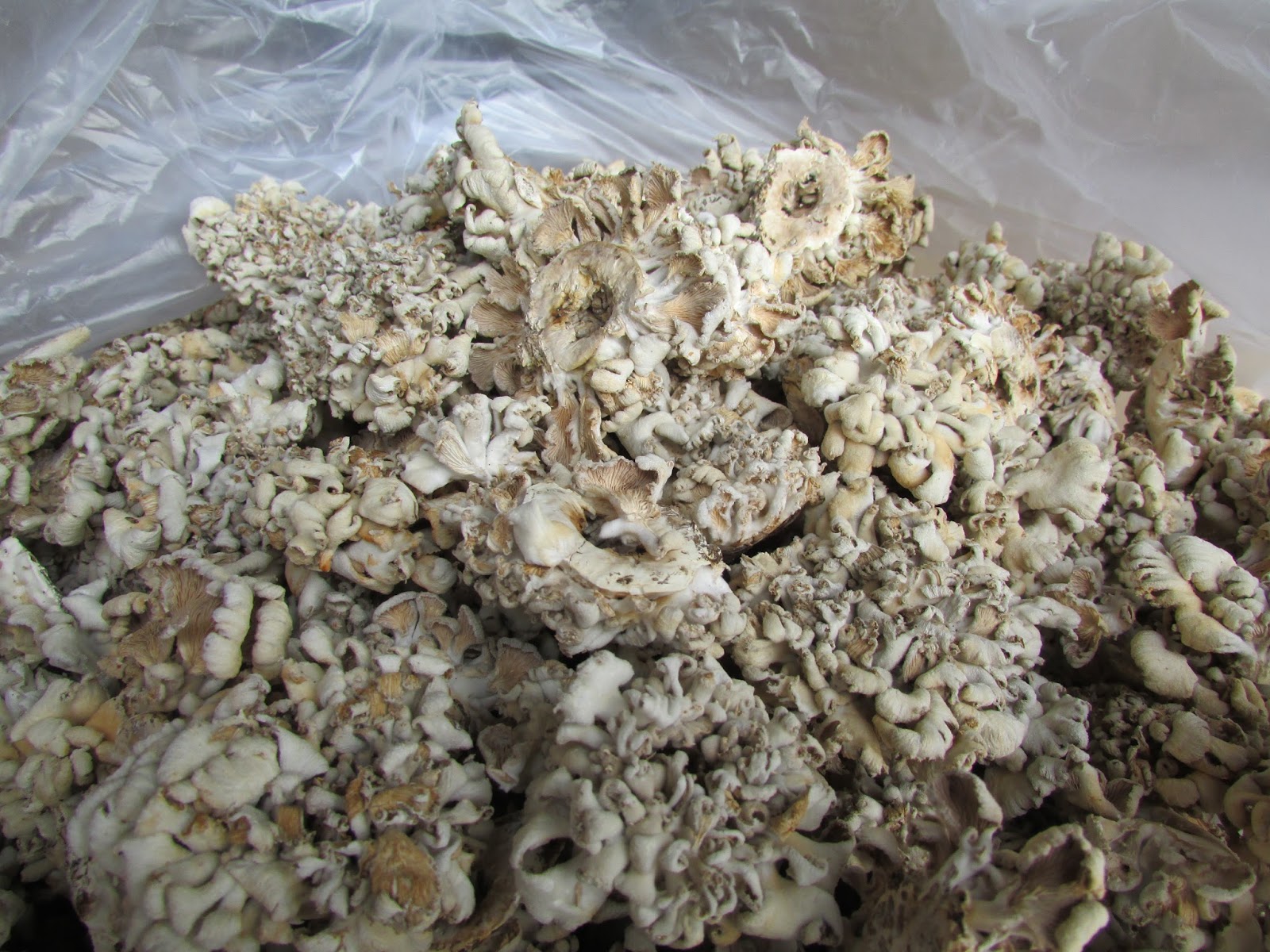
 Harvest ear mushroom (Auricularia fuscosuccinea) 

 On the bank of Dianchi Lake in Kunming


 Beautiful Kunming International airport


D. Jayarama Bhat


(Concluded)